
'As far as I'm concerned, how effective the Rafale was or frankly, how effective other systems were -- to me, the proof of the pudding is the destroyed and disabled airfields on the Pakistani side'

Villagers living near the International Border and Line of Control in Jammu are on high alert following the recent terror attack in Pahalgam, preparing underground bunkers and accelerating crop harvesting. The incident has heightened security concerns despite a renewed ceasefire agreement between India and Pakistan in 2021. Residents are demanding swift action against the perpetrators and their handlers.

A villager was killed and three others were injured in shelling by Pakistan in forward areas of Jammu and Kashmir's Poonch and Rajouri districts early Friday morning, prompting Army troops to retaliate. The shelling also caused significant damage to property, with many houses and hundreds of vehicles affected. The firing and shelling were directed at areas in Rajouri, Poonch, and Jammu districts, apart from Kashmir's Kupwara and Baramulla districts, overnight.

The Pakistani military fired unprovoked shots across the Line of Control (LoC) in Kashmir for a second consecutive night, triggering retaliatory action from Indian troops. This escalation follows heightened tension between India and Pakistan after the Pahalgam terror attack that killed 26 civilians. Despite the exchange of fire, no casualties were reported. India has imposed a series of punitive measures in response to the attack, including the suspension of the Indus Waters Treaty and closing the Attari land-border crossing. Pakistan has responded in kind, closing its airspace to Indian airlines and suspending trade with India.

Pakistan's Olympics gold-winning javelin thrower Arshad Nadeem's Instagram account has been blocked in India owing to a "legal request" in the aftermath of the Pahalgam terror attack.

Sarma had earlier said the state-wide crackdown on traitors would continue, and nobody would be spared.

The Attari-Wagah border crossing point between India and Pakistan was shut completely on Thursday following a week-long heavy rush of people from either side to cross over after the Union government ordered all Pakistani citizens with short-term visa to leave India in the wake of the Pahalgam terror attack, sources said.

Heavy security has been deployed at vital installations in Delhi, including government buildings and areas with high footfalls, following Pakistan's drone attacks on Indian military sites. Police have strengthened vigil in areas with high footfalls and have canceled leaves for all Delhi Police personnel. The developments come after India swiftly thwarted Pakistan's attempts to strike military sites with drones and missiles.
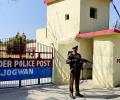
The armies of India and Pakistan on Thursday held a brigade commander-level flag meeting along the Line of Control (LoC) in Jammu and Kashmir's Poonch district to discuss issues related to border management.

The landmine exploded when the troops were patrolling in a forward area in Digwar sector this afternoon, the officials said.

The worst-hit in the Pakistani shelling was Poonch district which accounted for all the civilian deaths, the officials said, adding 28 persons were also injured and the condition of some of them was stated to be critical.

The talks over the hotline were previously scheduled at 12 noon. The reason for deferring the talks by few hours is not immediately known.

Following the Pahalgam terror attack, the Indian Army launched Operation Sindoor, targeting Pakistani terror infrastructure and posts in the Poonch sector of Jammu and Kashmir. Over 600 artillery shells were fired in three days, decimating 20 Pakistani posts used for infiltrating terrorists into India. The precision strikes crippled enemy logistics, material, and morale, prompting retaliatory attacks by Pakistan on civilian areas. Despite the retaliation, Indian Army officers described the operation as a success, highlighting the high morale of the troops and the effective coordination between artillery and air defense units. The article details the intensity of the artillery shelling and the impact on both sides, highlighting the strategic significance of the Poonch sector and the ongoing tension between India and Pakistan.

A search operation by a joint team of security forces is underway to track down three Pakistan-based Jaish-e-Mohammad (JeM) terrorists in a forested area of Udhampur district in Jammu and Kashmir on Friday, officials said on Friday.

He said Prime Minister Narendra Modi has made it "very clear" that any talks with Pakistan will be only on terror.

The home ministry said the central government would continue to welcome the discussion with LAB and KDA through the high powered committee on Ladakh or any such platform.

Congress leader Rahul Gandhi visited Poonch in Jammu and Kashmir, offering condolences to families affected by cross-border shelling and encouraging students who lost two classmates to the violence. During an hour-long visit, Gandhi met with students at the convent school that lost the twins, and visited families whose homes were damaged in the shelling.
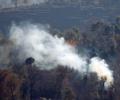
Pakistani troops continued to violate the ceasefire along the Line of Control (LoC) by resorting to unprovoked firing in Jammu and Kashmir's Poonch and Kupwara districts, army officials said. This was the fourth consecutive night that Pakistan resorted to unprovoked firing along the LoC and came amid heightened tension between New Delhi and Islamabad following last week's terror attack in Pahalgam. Indian troops responded swiftly and effectively.
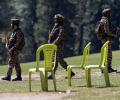
The officials said that intelligence agencies had been alerted about the possibility of a terror attack, but the inputs were utilised at another place, some 90 kilometres away from the site where the attack took place, resulting in a key security lapse.

The Director Generals of Military Operations (DGMOs) of India and Pakistan on Monday deliberated on various aspects of the May 10 understanding reached between the two sides on cessation of hostilities.

'Operation Sindoor is still ongoing. The Prime Minister himself said that blood and water cannot flow together, that talks and terrorism cannot go together. So how can we have a cricket match with a country that indulges in terrorism?'
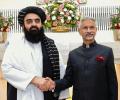
'Pakistan is uncomfortable with the Indian presence in Afghanistan. They want the Taliban to ensure that there is no Indian presence in Afghanistan.'
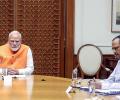
India's National Security Advisor Ajit Doval briefed US Secretary of State Marco Rubio on the country's missile strikes against nine terrorist targets in Pakistan. The strikes, dubbed "Operation Sindoor," targeted terrorist infrastructure in Pakistan and Pakistan-occupied Jammu and Kashmir. India stated that the strikes were measured, responsible, and non-escalatory in nature, targeting only known terror camps. The strikes followed a deadly attack on civilians in Jammu and Kashmir on April 22, for which India has accused Pakistan-based terrorists. The Indian government has cited credible leads, technical inputs, and survivor testimony as evidence of Pakistan's involvement in the attack.
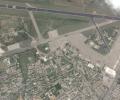
India's strikes on Pakistan damaged runways and structures across at least six airfields, according to a visual analysis by The Washington Post, which experts said were the most significant attacks of their kind in decades of simmering conflict between the two nations.

'If they can be duplicitous, we can be equally duplicitous.' 'If they offer friendship, we reciprocate.' 'If they choose hostility, we respond with equal hostility.'

The Instagram accounts of leading current and former Pakistani cricketers were blocked in India on Friday.

In an interaction with naval warriors on board aircraft carrier INS Vikrant off Goa, Singh sent a stern warning to Islamabad saying India will not hesitate to use the methods to deal with terrorism that Pakistan cannot even think of.

Pakistani military targets at Rafiqui, Murid, Chaklala, Rahim Yar Khan, Sukkur and Chunian were engaged using air-launched precision weapons from Indian fighter jets and the retaliation largely focused on command and control centres, radar sites and weapon storage areas, Qureshi said.

Authorities in Jammu and Kashmir on Sunday asked border villages residents, who were evacuated to safer places in view of cross border shelling by Pakistan, not to rush back to homes as they are yet to sanitise and clear these areas of any unexplored shells.
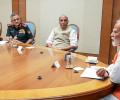
'If Pakistan has fired one bullet at us then we have to respond by firing 10 bullets at them. It is our right to do so.'
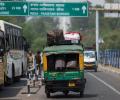
For Ali, who hails from Mendhar sub-division near the Line of Control (LoC) in Poonch district, the uniform is more than a job -- it's a calling. He has dedicated nearly half his life in the police force, serving its various wings with distinction and earning multiple commendations for his courage and unwavering commitment to duty.
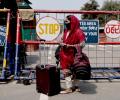
The Supreme Court on Friday directed authorities not to deport to Pakistan six members of a family, who allegedly overstayed their visa, till their citizenship claim is verified.

'We will take all necessary steps to ensure that Abir Gulaal is not released in India.'

He added, "You can never trust Pakistan as long as the Pakistani deep state, Pakistani ISI, Pakistani military's objective is to destabilise Bharat."
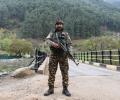
It is time we buried the mantra of 'peaceful and stable Pakistan is in our interest'. It is not, simply because Pakistan's existence -- that is synonymous with its army -- means peace has no chance, asserts Colonel Anil A Athale (Retd). It is time we buried the mantra of 'peaceful and stable Pakistan is in our interest' asserts Colonel Anil A Athale (Retd).

Pakistan's star javelin thrower Arshad Nadeem has refused to comment on his arch-rival Neeraj Chopra.
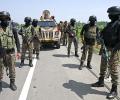
India needs to be technologically and militarily prepared to defend itself from both Pakistan and China, alerts Ramesh Menon.

In response to a question on President Donald Trump offering to "mediate" on the issue of Kashmir, Bruce said, "Well, I - obviously, I can't speak to what's on the mind or the plans of the President. What I do know is that I think we all recognise that President Trump in each step that he takes, it's made to solve generational differences between countries, generational war."

In a post on X, he said the people of Balochistan have given their "national verdict" and that the world must no longer stay silent.

Under Operation Sindoor, Indian armed forces not only struck Pakistani military bases near the border but their might was even felt in Rawalpindi where the headquarters of the Pakistani Army is located, Defence Minister Rajnath Singh said on Sunday.
